Vibration plates and resistance bands are two of the most space-efficient tools in home fitness, and combining them multiplies the challenge without adding equipment. A vibration plate workout with resistance bands adds external load to the unstable surface, so your muscles fight both the platform’s oscillation and the band’s tension at once. The result: more muscle activation per minute and a stronger stimulus for balance, bone density, and upper-body strength. Below is exactly how to set it up, which exercises work, and how to stay safe.
Key Takeaways
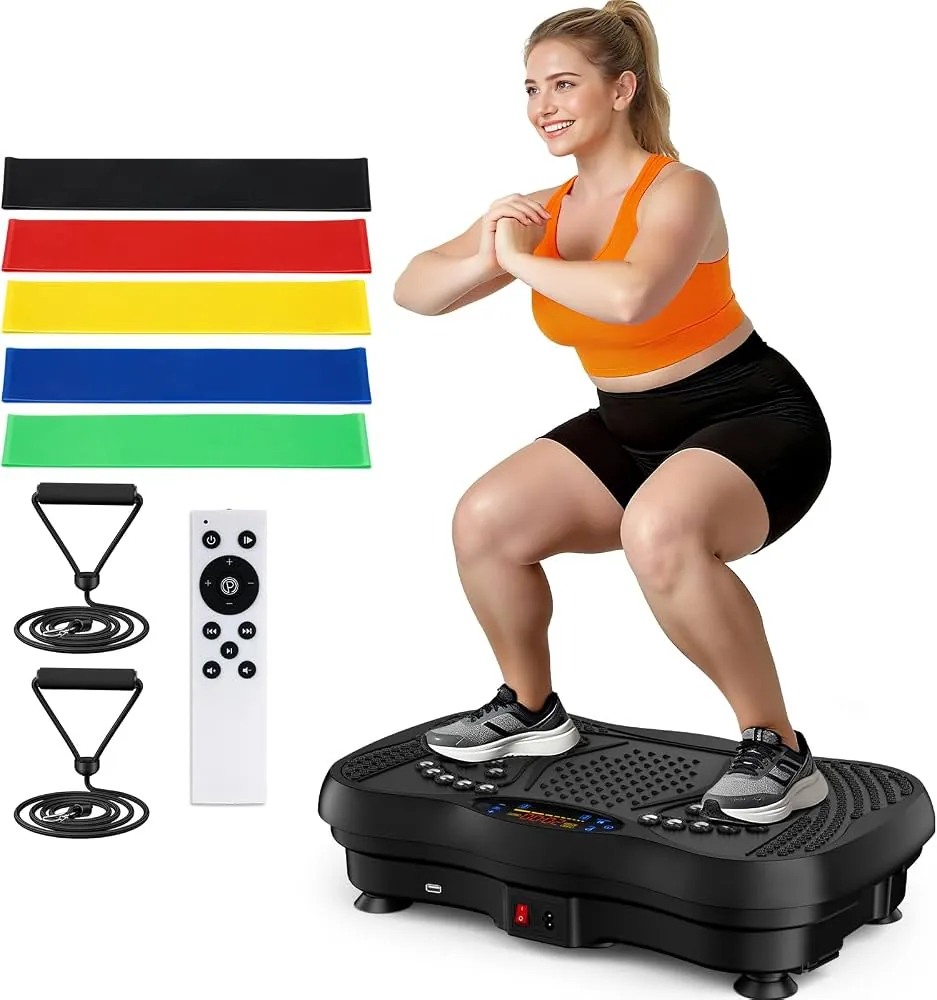
- Use flat latex or fabric loop bands — tube bands with handles slip off a vibrating surface.
- Anchor bands under your feet or around the platform’s base, never around the moving plate’s edge.
- Start at low frequency (20–30 Hz) and low amplitude for your first two weeks.
- Keep sessions to 10–20 minutes, three to four times per week; vibration is a stimulus, not a marathon.
- Hold each banded position for 30–60 seconds or perform 10–15 controlled reps.
- Skip vibration training entirely if you’re pregnant, have a pacemaker, or have a recent fracture.
Why Combine Bands With Vibration?
A vibrating platform sends rapid, low-amplitude oscillations through your body, forcing muscles to make constant micro-adjustments. Adding a band introduces progressive resistance on top of that instability. According to the American College of Sports Medicine, combining resistance training with balance challenges improves both strength and stability more than either alone in older adults. The band also lets you load movements — rows, presses, squats — that bodyweight alone can’t challenge on a plate.
Choosing Resistance Bands for Your Vibration Plate
Not every band survives a vibrating surface. Loop bands in flat latex or woven fabric stay put; tube bands with plastic handles swing and catch. Match the band to the movement:
| Band Type | Best For | Typical Resistance |
|---|---|---|
| Mini loop (flat latex) | Glute bridges, lateral walks | 10–30 lb |
| Long loop (fabric) | Squats, rows, presses | 20–60 lb |
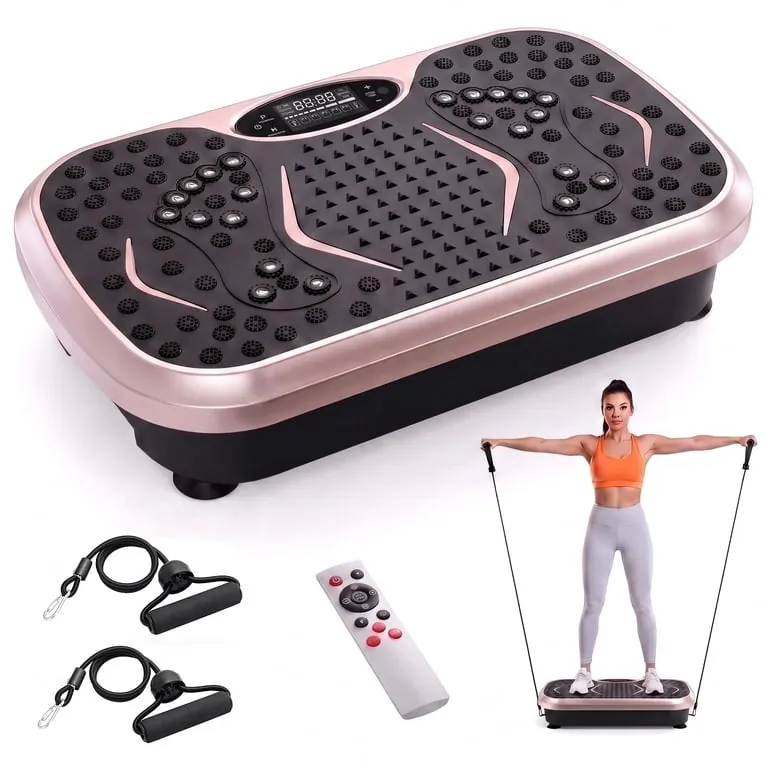
| Tube with handles | Overhead press (standing off-plate) | 15–50 lb |
| Figure-8 | Chest press, shoulder raises | 10–40 lb |
Pro Tip: Buy two or three resistance levels. Bands lose tension as you fatigue, so having a lighter option keeps form clean on the last set.
Setting Up Safely
- Place the plate on a hard, level floor — not carpet, which dampens vibration and destabilizes the base.
- Stand or sit centered; keep feet hip-width for balance.
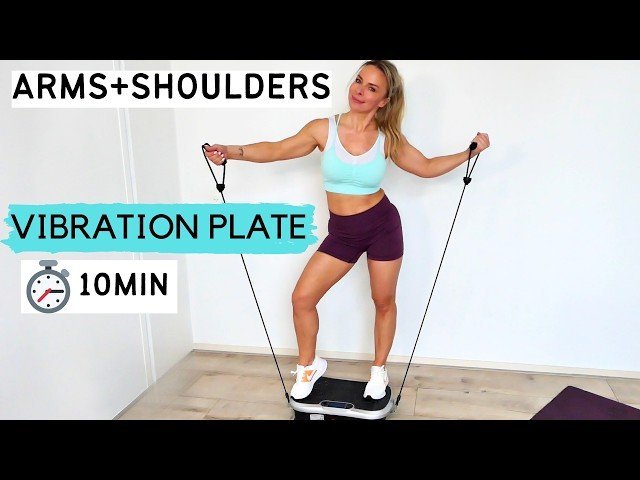
- Anchor long loop bands under both feet or loop them around a sturdy fixed object beside the plate, not the plate itself.
- Start the plate before adding band tension, so you aren’t fighting both at once.
- Keep a chair or wall within arm’s reach for the first sessions.
Warning: Never wrap a band around the plate’s moving edge or handle. Vibration can fray the band and snap it toward your face.
Best Exercises to Try
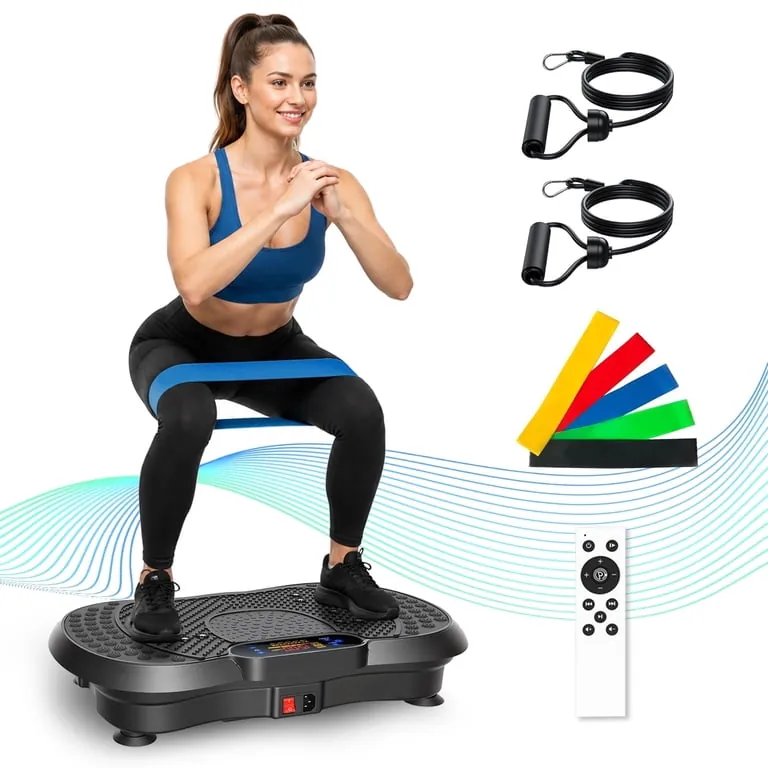
Lower Body
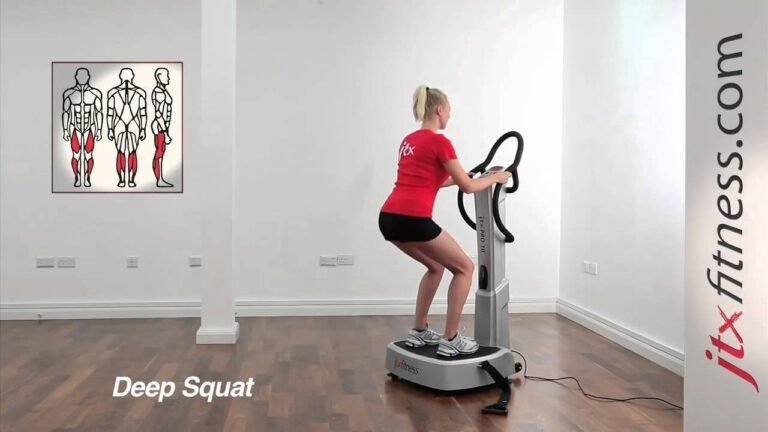
- Banded squat: Stand on the plate, loop a long band under both feet, bring handles to shoulders. Squat to parallel.
- Lateral band walk: Mini loop above knees, quarter-squat, step side to side on the plate.
- Glute bridge: Sit or lie with hips on the plate, mini loop above knees, drive hips up.
Upper Body
- Banded row: Loop a long band around a fixed post, sit on the plate, pull handles to ribs.
- Chest press: Figure-8 band behind your back, press forward while standing on the plate.
- Overhead press: Stand on the plate, band under feet, press handles overhead.
Core
- Pallof press: Band anchored to the side, stand on the plate, press straight out and resist rotation.
- Banded dead bug: Loop a mini band around feet, lie beside the plate with hands on it for feedback.
Sample 15-Minute Session
| Time | Block | Details |
|---|---|---|
| 0–2 min | Warm-up | Plate on, no bands, march in place |
| 2–7 min | Lower body | Squat, lateral walk, glute bridge — 45 sec each |
| 7–12 min | Upper body | Row, chest press, overhead press — 45 sec each |
| 12–15 min | Core + cool-down | Pallof press, dead bug, then plate off and stretch |
Frequency and Progression
Aim for three to four sessions per week with a rest day between. Increase difficulty in this order: longer holds first, then heavier bands, then higher frequency. Most home plates run 20–50 Hz; stay at the low end until you can hold every position for 60 seconds without wobbling.
Common Mistakes to Avoid
- Holding your breath — breathe through each rep; vibration already raises your heart rate.
- Gripping the handles too hard — relax your forearms or you’ll fatigue before your target muscle does.
- Skipping the warm-up — cold muscles plus vibration equals sore joints.
- Training on a soft rug — the plate needs a firm surface to transmit vibration correctly.
Frequently Asked Questions
Can beginners use bands on a vibration plate?
Yes, but start with bodyweight only for the first week. Add a light mini loop band once you can stand balanced for 60 seconds with the plate running. Beginners should keep frequency at 20–25 Hz.
How long should a banded vibration session last?
Ten to twenty minutes is plenty. Vibration training is intense per minute; longer sessions raise injury risk without adding much benefit. Three to four short sessions weekly beat one long one.
Do resistance bands actually add benefit on a plate?
Yes. The band adds external load, so muscles work against both tension and instability. This increases activation in the glutes, core, and upper back compared with bodyweight-only plate work.
Is it safe if I have back problems?
Ask your physician first. Vibration can aggravate disc issues and recent injuries. If cleared, use low frequency, hold a support, and avoid loaded spinal flexion like banded good mornings.
What frequency and amplitude should I use?
Start at 20–30 Hz with low amplitude. Once you’re comfortable, work up to 35–40 Hz. Amplitude matters more than frequency for beginners — keep it low until balance improves.
Can I do this every day?
No. Give muscles 24–48 hours between banded sessions. Daily use of the plate alone for circulation or mobility is fine, but loaded band work needs recovery.
(See above — all questions answered in the section preceding this note.)
Conclusion
Pick two lower-body and two upper-body exercises from the list, set your plate to 25 Hz, and run the 15-minute session three times this week. Log which band you used for each move. Next week, either add five seconds to every hold or grab the next-heavier band — that single progression rule will keep you improving for months without ever needing more equipment.

I am a certified fitness coach with over 10 years of experience helping people improve their strength, endurance, and overall health. Specializes in workout programming, weight training, fat loss, muscle building, home fitness, and evidence-based nutrition.My goal is to make fitness simple and practical through well-researched guides, honest product reviews, and actionable training advice.