
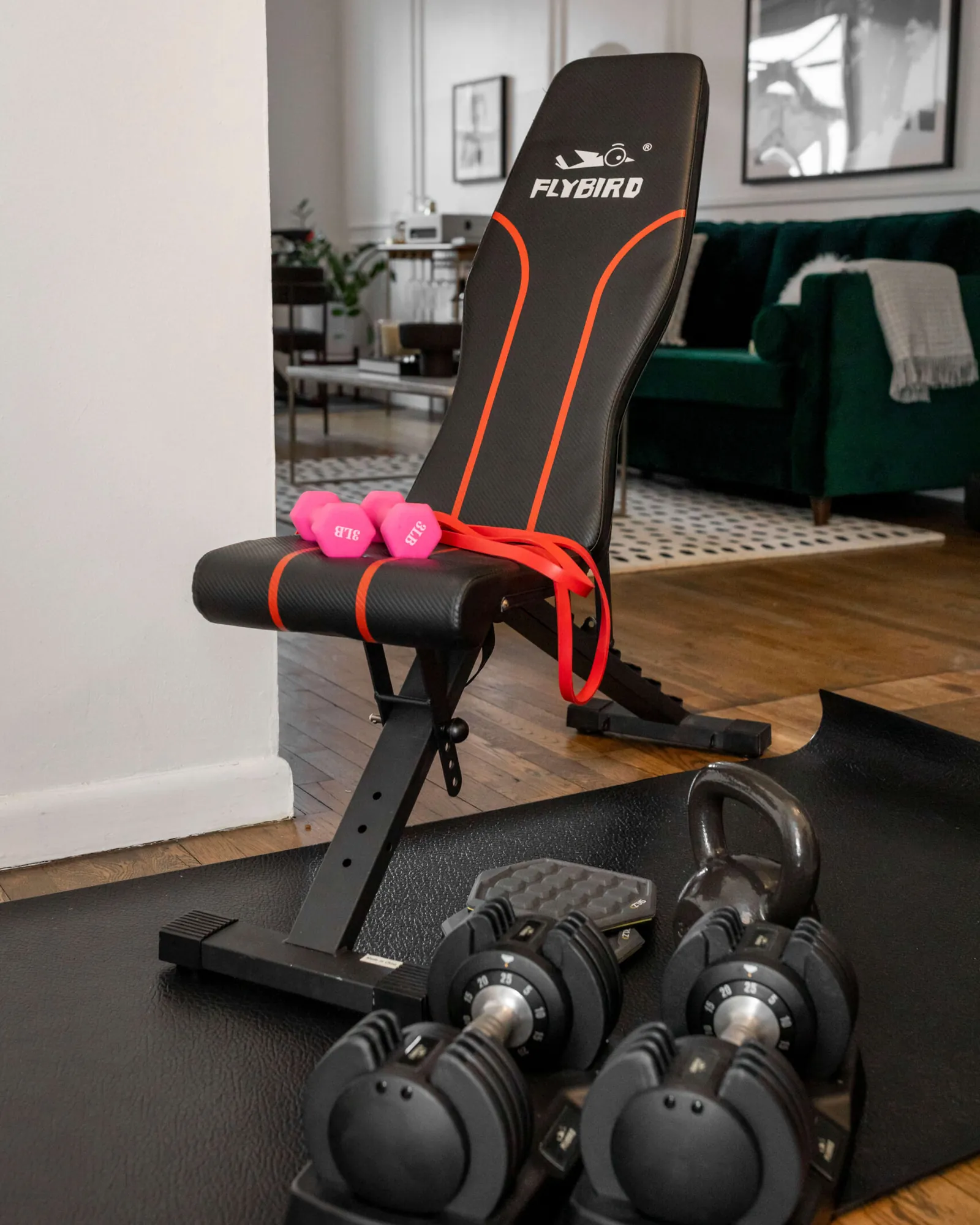
Resistance bands, a jump rope, a yoga mat, sliders, a kettlebell, and a doorway pull-up bar are the core of home workouts for small apartments. What separates them is floor space, noise, and how much weight they add to a closet.
Home workouts in small apartments gear

Every item below fits in a bag you can push under a bed. The table shows what each one is best for and a common example you’d recognize.
| Item | Best for | Example |
|---|---|---|
| Resistance bands | Full-body strength, travel | Loop band set |
| Jump rope | Cardio in one spot | Speed rope with bearings |
| Yoga mat | Floor work, stretching | 6 mm thick mat |
| Sliders | Core and leg control | Two disc sliders |
| Kettlebell | Swings, squats, carries | 16 lb kettlebell |
| Doorway pull-up bar | Back and arms | No-screw tension bar |
| Suspension trainer | Bodyweight strength | Door-anchor strap system |
Resistance bands
Resistance bands give you a full strength session with no weights and no noise. Stack two bands for more resistance, or step wider on the band to increase tension.
- Builds pulling strength for your back and arms with rows and pull-aparts
- Trains legs with squats and lateral walks, no rack needed
- Packs into a pocket for travel or a small drawer at home
- Lets beginners start light and add tension gradually
A concrete example: anchor a long band in a closed door at hip height and do 3 sets of 12 rows, stepping back until the band feels tight at the start.
Jump rope
A jump rope delivers real cardio in a 3-foot square. Most people need about 2 feet of clearance above their head to swing the rope cleanly.
- Raises your heart rate fast for short, intense sessions
- Improves coordination and foot speed
- Fits in a bag and needs no setup
- Works as a warm-up before strength work
For example, jump for 30 seconds and rest 30 seconds, repeating 10 times — about 10 minutes total. On a hard floor, use a mat underneath to cut the noise.
Yoga mat
A yoga mat is the base layer for floor work, stretching, and floor moves. A 6 mm mat cushions joints; a thinner 3-4 mm mat gives more grip and stability for balance poses.
- Protects knees, hips, and elbows during floor exercises
- Gives grip so your hands don’t slide in planks
- Defines your workout zone in a shared room
- Rolls up and stores in a corner
One limit worth naming: a mat won’t help if your floor is already painful to kneel on.
Sliders
Sliders are two smooth discs you put under your hands or feet for core and leg moves. The discs force your muscles to control movement, not just hold still.
- Trains your core with sliding mountain climbers and body saws
- Works inner thighs with sliding lunges
- Adds difficulty without any added weight
- Stores flat in a drawer
A concrete example: put sliders under your feet in a plank and slide both knees toward your chest for 3 sets of 10 slow reps.
Kettlebell
A kettlebell is one weighted bell you swing, squat, and carry for strength and conditioning. A 16 lb (about 7 kg) bell is a common starting point for many adults.
- Builds power with swings and cleans
- Trains grip and core with carries
- Replaces several dumbbells for basic moves
- Takes up less space than a rack
One limit: kettlebell swings and cleans need coaching to avoid back strain. If you’ve never done one, get a session with a certified trainer before adding weight.
Doorway pull-up bar
A doorway pull-up bar turns any doorframe into a pull-up station for your back and arms. Check your doorframe width and trim before buying — the bar’s packaging lists the sizes it fits.
- Trains back, shoulders, and arms with pull-ups and hangs
- Uses zero floor space
- Removes in seconds when guests arrive
- Adds grip strength through dead hangs
For example, do 3 sets of 5 assisted pull-ups with a chair under one foot, lowering slowly on each rep.
Other gear worth knowing
A few more tools round out a small-apartment setup, each with a clear job.
- Suspension trainer — straps anchored to a door train your whole body using your own weight; good if you want variety without a rack.
- Ab wheel — a single rolling wheel for core work; best for someone already comfortable with planks.
- Mini loop bands — small fabric or latex loops for glute and hip work; ideal as a warm-up tool.
- Foam roller — a cylinder for loosening tight muscles after training; suits anyone sore from floor work.
- Adjustable dumbbells — one pair that changes weight; best if you’ve outgrown bands and want real load.
Picking the right gear for your space
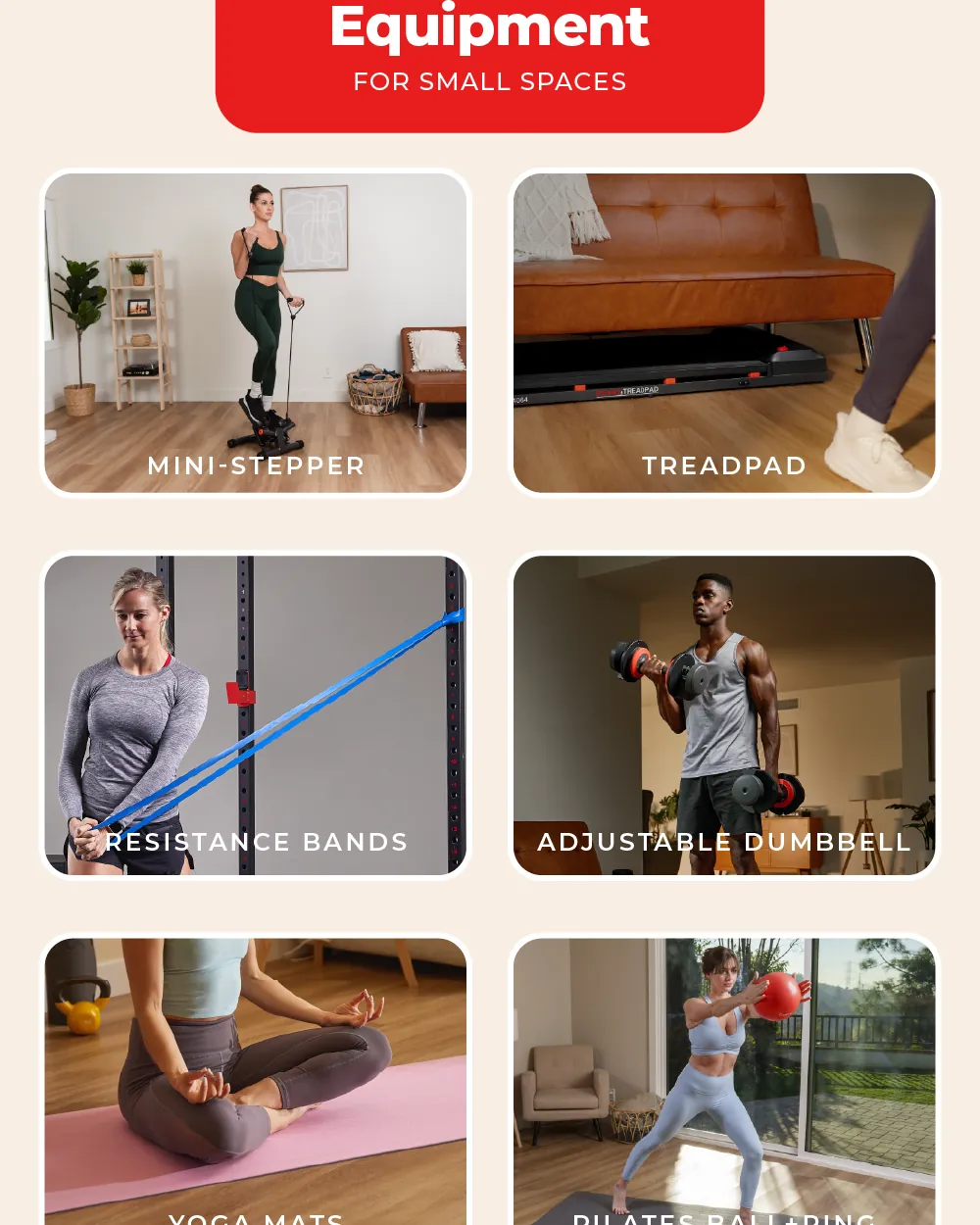
Your floor space, your noise limits, and your goal decide which item is yours. If you have under 4 square feet free, pick resistance bands or a jump rope. If noise bothers the neighbors below, choose bands, sliders, or a kettlebell. To build visible muscle, choose a kettlebell or adjustable dumbbells.
You can combine items, but each one you add costs money and closet space. Pick one strength tool and one cardio tool first, then add more once you know you’ll use them.
Frequently asked questions
Can you really build muscle with home workouts in a small apartment?
Yes, if you add resistance over time. Bands, kettlebells, and pull-ups create enough tension when you push close to failure and increase difficulty every week or two.
How much space do I need for a home workout?
About 6 feet by 6 feet of clear floor, roughly a yoga mat plus arm room. For jump rope, you also need about 2 feet of clearance above your head.
Is jumping rope in an apartment too noisy for neighbors?
Often yes, on a bare hard floor. A thick exercise mat under you cuts the sound a lot.
How long should a small apartment workout last?
20 to 40 minutes is enough for most people, three to four days a week.
What happens if I skip a warm-up before floor work?
You raise your injury risk, especially for knees, wrists, and lower back. Spend 3 to 5 minutes on light movement and dynamic stretches first.
Does a doorway pull-up bar damage the frame?
Tension bars can leave marks or compress trim on some frames. Check the bar’s listed doorframe width and weight limit before installing.
Is it safe to train alone at home?
For most healthy adults, yes. Stop and get medical help if you feel chest pain, dizziness, or sharp joint pain.
How often should I increase the resistance?
Every 1 to 2 weeks, once the current level feels easy for all your sets. Add a band, a heavier bell, or one more rep.
Start with one strength tool and one cardio tool
Pick a resistance band and a jump rope today, and set a 20-minute timer three times this week. Expect to feel worked but not wrecked, and to see easier reps within two weeks. If you feel sharp pain or dizziness, stop and see a doctor.
I am a certified fitness coach with over 10 years of experience helping people improve their strength, endurance, and overall health. Specializes in workout programming, weight training, fat loss, muscle building, home fitness, and evidence-based nutrition.My goal is to make fitness simple and practical through well-researched guides, honest product reviews, and actionable training advice.