
A vibration plate’s motor is the single part that decides whether the machine shakes hard enough to matter or just hums politely under your feet. Motor power on consumer vibration plates typically runs from 200 watts to 1,000 watts, with most mid-range home units landing between 300 W and 500 W. That number, plus how the motor is geared, tells you far more about real performance than the marketing watts printed on the box.
Key Takeaways
- Look for 200–1,000 W as the realistic range for home vibration plates; commercial gym units run higher.
- Continuous (RMS) power matters more than peak power, which is a momentary spike.
- A 300–500 W motor with good gearing usually outperforms a cheap 800 W claim.
- Motor type — AC vs DC — affects noise, lifespan, and cost more than raw wattage.
- Amplitude (the up-down travel distance) and frequency (Hz) often matter more than watts for results.
- Overheating, burning smell, or a motor that stalls under load means the rating is inflated or the unit is failing.
What Motor Power Actually Means
Motor power is the rate at which the motor converts electrical energy into the mechanical force that drives the plate up and down. It’s measured in watts (W). A higher-wattage motor can move a heavier load and sustain higher frequencies without bogging down.
But watts alone are misleading. Two plates rated at 500 W can perform completely differently depending on gearing, the weight of the oscillating mechanism, and whether the rating is peak or continuous.
Peak vs Continuous Power
This is the most common trap in vibration plate marketing.
| Rating Type | What It Means | Real-World Value |
|---|---|---|
| Peak power | Maximum momentary output, often for a split second | Inflated; rarely sustained |
| Continuous (RMS) | Power the motor can hold indefinitely | The number that matters |
| Stall torque | Force before the motor gives out | Determines max user weight |
If a listing only says “1000W” with no qualifier, assume it’s peak. A genuine 400 W continuous motor is a stronger machine than a 1000 W peak-rated one.
AC vs DC Motors
Vibration plates use one of two motor types, and the choice shapes everything else.
- AC motors — run on mains alternating current, generally more durable, quieter at high duty cycles, common in commercial and higher-end home plates.
- DC motors — run on converted direct current, cheaper to produce, lighter, common in budget and portable plates. They tend to wear faster and can whine under load.
For daily home use, a well-built DC motor at 300–500 W continuous is fine. For shared, heavy, or near-continuous use, AC wins on lifespan.
How Much Power Do You Need?
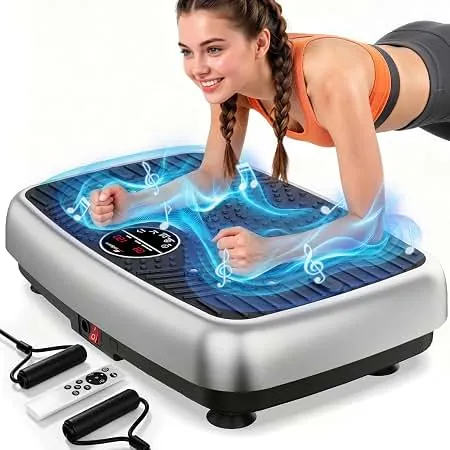
Match the motor to your body weight and how hard you’ll push it.
| User / Use Case | Suggested Continuous Power |
|---|---|
| Light use, under 150 lb | 200–300 W |
| Average adult, 150–200 lb | 300–500 W |
| Heavier users, 200 lb+ | 500–800 W |
| Commercial / multi-user | 800 W+ |
Pro Tip: Check the stated maximum user weight on the spec sheet, not just the watts. A 500 W motor rated for 300 lb will handle a 250 lb user far better than a 600 W motor rated for 220 lb.
Why Watts Aren’t the Whole Story
Two other specs do more for your results than raw power.
Frequency (Hz)
Frequency is how many times per second the plate oscillates. Most plates run 5–50 Hz. Higher frequencies suit toning and circulation work; lower frequencies suit balance and mobility training.
Amplitude (mm)
Amplitude is the vertical travel distance, usually 0–10 mm. Larger amplitude means a bigger, more demanding movement. A low-power motor paired with large amplitude will strain; a strong motor with tiny amplitude feels weak.
Signs a Motor Rating Is Inflated
- The plate stalls when you shift your weight onto it.
- The motor bogs down at higher frequencies.
- It overheats or smells hot within 15 minutes.
- The listed watts are far above everything else in its price bracket.
- No continuous/RMS figure is published anywhere.
Warning: A burning smell, grinding noise, or a motor that cuts out repeatedly is a safety issue, not a break-in quirk. Stop using the unit and check the manufacturer’s guidance. Electrical products sold in the US should carry UL or ETL certification; you can verify standards and certification details through UL Solutions.
Matching Vibration Plate Motor Power to Your Goals
- Weight loss / general fitness: 300–500 W continuous is plenty; focus on consistent 10–15 minute sessions.
- Muscle toning: prioritize frequency range and amplitude over watts.
- Rehabilitation / balance: lower amplitude and lower power are safer and more controllable.
- Athletic training: higher power (600 W+) with wide amplitude and high frequency.
Motor Power and Noise
More power doesn’t automatically mean more noise — but cheap high-wattage motors often are louder. AC motors tend to run quieter and smoother. If you live in an apartment, prioritize a quiet AC unit at 300–500 W over a loud budget 800 W DC plate.
Maintenance That Protects the Motor

- Keep the unit on a hard, level floor — carpet traps heat.
- Don’t exceed the max user weight.
- Limit continuous sessions to the duty cycle in the manual (often 10–20 minutes).
- Keep vents dust-free.
- Let it cool between sessions.
Related guides
- Weight Plates Kg Vs Lbs Conversion
- Weight Plates Workout Routines for Beginners at Home
- Maintenance Tips for Power Rack: Keep It Safe and Sturdy
Frequently Asked Questions
Is a higher wattage vibration plate always better?
No. Continuous power matters more than peak watts, and frequency, amplitude, and build quality often affect results more. A well-made 400 W plate beats a poorly built 900 W one for most home users.
What’s a good wattage for a home vibration plate?
For most adults, 300–500 W continuous covers daily home use comfortably. Go higher only if you’re heavier, train hard, or share the machine with multiple users.
Why does my vibration plate slow down when I stand on it?
That’s the motor losing torque under load, meaning the power rating is likely peak rather than continuous, or the unit is under-spec’d for your weight. Check the max user weight against your own.
Do vibration plates burn fat on their own?
No machine burns fat without a calorie deficit. Vibration plates can add muscle activation and circulation benefits to a routine, but they complement diet and exercise rather than replace them.
How long should a vibration plate motor last?
A quality motor used within its duty cycle can last several years. Budget DC motors in cheap plates often degrade within a year or two of daily use.
Can I replace a vibration plate motor?
Rarely worth it. Motors are usually integrated and brand-specific, and replacement cost plus labor often approaches the price of a new unit.
Conclusion
Pick your plate by continuous watts, amplitude, and frequency together, not by the biggest number on the box. Before buying, find the spec sheet, confirm the continuous rating and max user weight, and check for UL or ETL certification — that combination tells you more than any single figure ever will.
I am a certified fitness coach with over 10 years of experience helping people improve their strength, endurance, and overall health. Specializes in workout programming, weight training, fat loss, muscle building, home fitness, and evidence-based nutrition.My goal is to make fitness simple and practical through well-researched guides, honest product reviews, and actionable training advice.