A beginner workout routine at home works best with 3 sessions a week, 20 to 30 minutes each, using only your bodyweight and one chair. You’ll train your legs, push, pull, and core in every session. This guide covers the exact moves, the sets and rest times, how to add weight later, and the warning signs that mean stop.
What a home routine really is
A home routine is a short list of strength moves you do in your own space, using your body weight instead of machines. It’s for anyone who wants to get stronger without a gym membership or a long commute.
The one misconception to drop: soreness isn’t progress. Real progress shows up as more reps, slower control, or harder versions of the same move.
How to do a beginner home workout routine, step by step
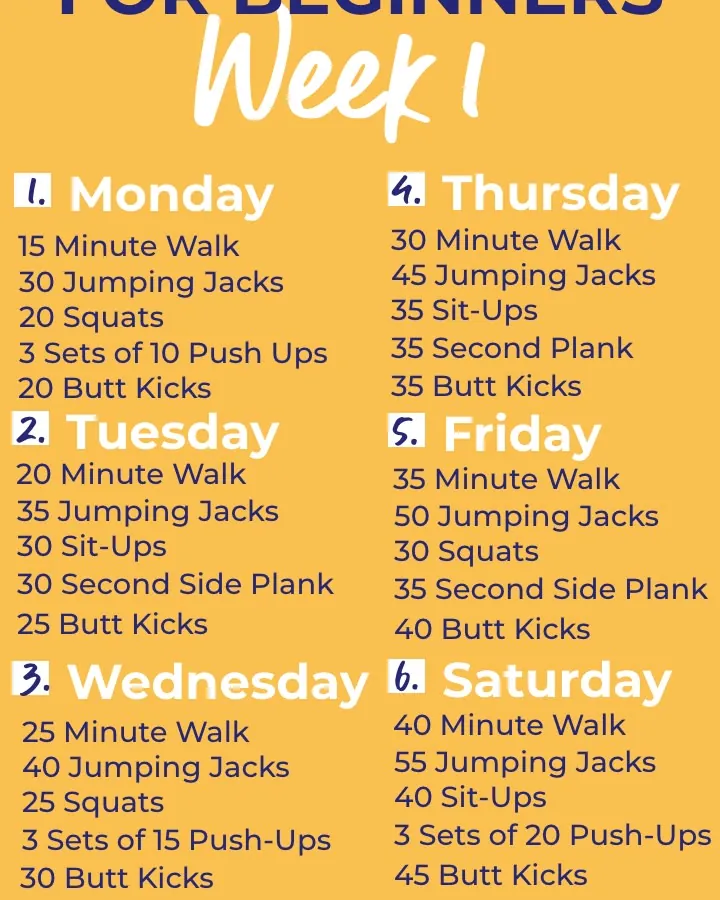
Do this on 3 non-back-to-back days, like Monday, Wednesday, and Friday. Warm up first with 2 minutes of marching in place and 10 slow arm circles each way. Then move through the list below.
- Chair squats — 2 sets of 8 to 12 reps. Stand in front of a chair, sit back until you lightly touch it, then stand. Rest 60 seconds between sets.
- Incline push-ups — 2 sets of 6 to 10 reps. Put your hands on a sturdy table or counter, body straight, lower your chest to the edge.
- Towel rows — 2 sets of 8 to 12 reps. Loop a towel around a closed door handle, lean back, and pull yourself toward the door.
- Glute bridges — 2 sets of 10 to 15 reps. Lie on your back, knees bent, lift your hips until your body makes a straight line.
- Dead bugs — 2 sets of 6 per side. Lie on your back, arms up, and lower one arm and the opposite leg slowly without arching your lower back.
- Standing calf raises — 2 sets of 12 to 15 reps. Rise onto your toes, pause 1 second at the top, lower slowly.
The judgement call that matters most is range of motion, not speed. A slow squat that stops where you can still control it beats 20 fast half-reps every time. If a move hurts a joint, stop that move and use an easier version.
Sets, reps, and rest at a glance
Use this table to match the routine to your current level. The “how long” column assumes you rest 60 seconds between sets and don’t rush.
| Situation | What to use | How long | What to watch for |
|---|---|---|---|
| First 2 weeks, very unfit | 1 set of each move, 6-8 reps | About 15 minutes | Stop while you still feel steady |
| Comfortable with 1 set | 2 sets of each move, 8-12 reps | 20-30 minutes | Keep 60-second rests honest |
| 2 sets feels easy | 3 sets, or slower lowering | 30-35 minutes | Don’t add sets and speed at once |
| Knee discomfort in squats | Sit-to-stand from a higher chair | Same as normal | Pain that stays past the set |
| Wrist pain in push-ups | Hands on a counter, not the floor | Same as normal | Numbness or tingling |
| No chair or table handy | Wall push-ups, floor bridges | Same as normal | Slippery floors |
| Only 10 minutes free | 1 set of all 6 moves | About 10 minutes | Don’t skip the warm-up |
What good form looks like
The people who get results from a home routine share a few habits. They pick a fixed time of day, so the session doesn’t depend on motivation.
If you can’t say how many reps you did last time, you can’t tell whether you’re improving.
They also work in a set order and keep it. Legs first, then push, then pull, then core.
What to check mid-session
Halfway through, ask one question: could I do 2 more clean reps on that last set? If yes, the move is too easy — slow the lowering phase to 3 seconds, or switch to a harder version. If you couldn’t finish the last rep with good form, drop a rep next time.
What to leave alone
Don’t add jumping, running, or heavy weights in the first month. Your joints and tendons adapt slower than your muscles, and that’s where early injuries come from. Boring and consistent beats hard and sporadic.
Common problems and quick fixes
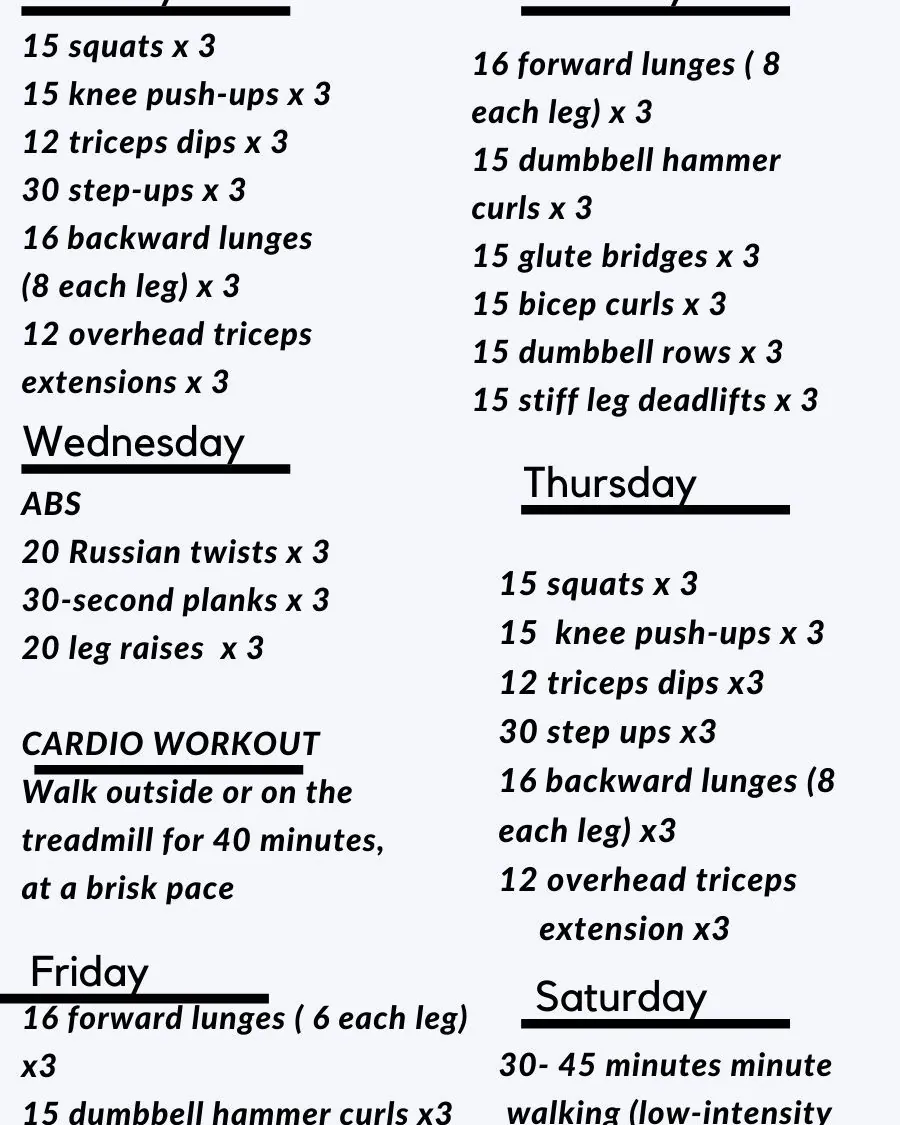
Most beginner problems have a simple cause. Match what you notice to the row below before you change the whole routine.
| What you notice | What it usually means | What to do first |
|---|---|---|
| Sharp knee pain in squats | Going too low too soon | Use a higher chair, reduce depth |
| Lower back aches in bridges | Hips lifting past a straight line | Stop at shoulder-hip-knee in line |
| Neck strain in dead bugs | Head lifting off the floor | Keep your head relaxed and down |
| No progress after 3 weeks | Same reps, same speed every time | Add 1 rep or slow the lowering |
| Dizzy or lightheaded | Holding your breath | Breathe out on the effort |
| Wrist pain in push-ups | Flat hands, full bodyweight | Raise hands to a counter or wall |
Safety rules and when to get help
Check with a doctor before starting if you have a heart condition, uncontrolled blood pressure, a recent injury, or you’re pregnant — the CDC’s page on physical activity basics lists the standard adult targets of 150 minutes of moderate activity a week plus 2 days of muscle work.
Stop and seek medical help for chest pain, fainting, or pain that doesn’t settle within a few days. A physical therapist handles joint pain that keeps coming back; a certified trainer can check your form in person. Don’t push through joint pain to finish a set.
Keeping the routine going
Log each session — date, move, sets, reps — in a notebook or phone. When you can hit the top of your rep range on every set with clean form, make one change: add a set, add 2 reps, or move to a harder version of one move. Change one thing at a time so you know what worked.
The sign it’s time to progress is simple: the last rep of your last set feels easy two sessions in a row. Then move up, not before.
When a home routine isn’t the right fit

Skip the home approach if you have a joint injury that’s still healing, since you need hands-on guidance. See a physical therapist first. If your goal is heavy lifting or a specific sport, a gym with a coach will get you there faster.
Related guides
- Weight Plates Workout Routines for Beginners at Home
- Ten Beginner Friendly Adjustable Dumbbells for Home Workouts
- Best Beginner Weights for Women 2026: Top Picks for Easy Home Workouts
Frequently asked questions
How many days a week should a beginner work out at home?
Three days a week, with a rest day between sessions. That gives each muscle group 48 hours to recover, which is when strength actually builds. Two days works if three won’t fit your week.
How long does it take to see results?
Most people notice easier reps and better stamina in 3 to 4 weeks. Visible muscle change usually takes 8 to 12 weeks, assuming you train 3 times a week and eat enough protein.
Is it safe to do this every day?
No. Daily strength training on the same muscles doesn’t give them time to repair. Do the routine 3 days a week, and on other days walk or stretch instead.
What happens if I skip the warm-up?
Cold muscles and joints move less freely, so the first set feels harder and strain risk goes up. Two minutes of marching in place and arm circles is enough.
Can I build muscle with no equipment?
Yes, for the first 2 to 3 months. Bodyweight moves like squats and push-ups build strength when you keep adding reps or slowing the lowering phase. After that, a backpack with books adds load.
How much rest between sets?
About 60 seconds for these moves. Shorter rests make the next set feel harder; longer rests are fine if you’re breathing hard, but keep it under 2 minutes.
What should I eat before a home workout?
Nothing heavy within an hour of training. A small snack like a banana 30 to 60 minutes before is fine. Drink water before, during, and after.
Conclusion
Start with the 3-day version this week. Write down your reps, keep the rests at 60 seconds, and add one small change only when the last rep feels easy. That’s the whole method.

I am a certified fitness coach with over 10 years of experience helping people improve their strength, endurance, and overall health. Specializes in workout programming, weight training, fat loss, muscle building, home fitness, and evidence-based nutrition.My goal is to make fitness simple and practical through well-researched guides, honest product reviews, and actionable training advice.