For most people, the best 4-day split is upper/lower done twice a week — it hits every muscle two times, and two sessions are short enough to finish on a busy day. If you’re chasing one lagging body part, a push/pull/legs plus a weak-point day wins instead.
Upper/lower, push/pull/legs and full body compared
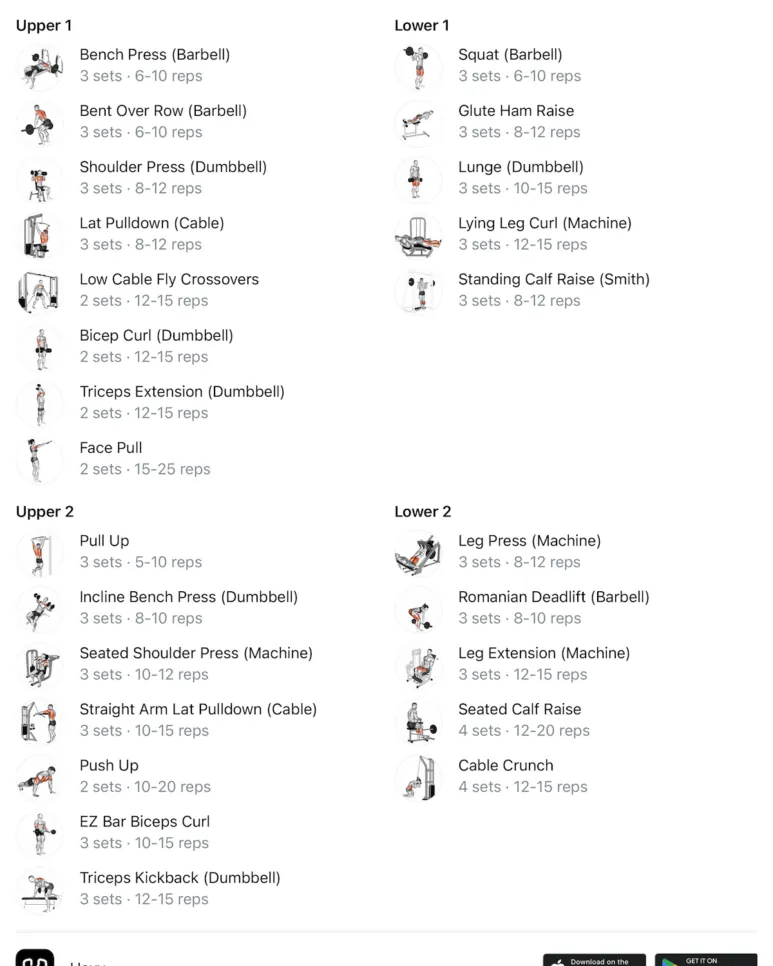
A 4-day split means training four days a week, with each muscle group on its own day or shared. The four common layouts differ in frequency, session length, and planning.
| Method | How long | Effort | Cost | Best for |
|---|---|---|---|---|
| Upper/lower, twice | 60-75 min | Medium | Low | Most people, any level |
| Push/pull/legs + weak point | 60-90 min | High | Low | One lagging muscle |
| Full body, four short days | 45-60 min | Medium | Low | Tight schedules |
| Body-part bro split | 60-90 min | Medium | Low | Advanced lifters only |
Cost here means money spent on a gym, gear or coaching — not a price. Check your own gym’s rates.
How upper/lower works
This is the layout to start with: each muscle gets trained twice a week without long sessions.
- Day 1 — upper: 4-5 exercises, 3 sets of 6-12 reps, 90 seconds rest.
- Day 2 — lower: 4 exercises, 3 sets of 5-10 reps, 2 minutes rest.
- Day 3 — rest.
- Day 4 — upper again, swapping the main lift for a different one.
- Day 5 — lower again, then two rest days.
It’s simple to plan and forgiving if you miss a day. Its weakness is boredom — the same two shapes repeat all month, so progress stalls if you never change the exercises.
How push/pull/legs plus a weak-point day works
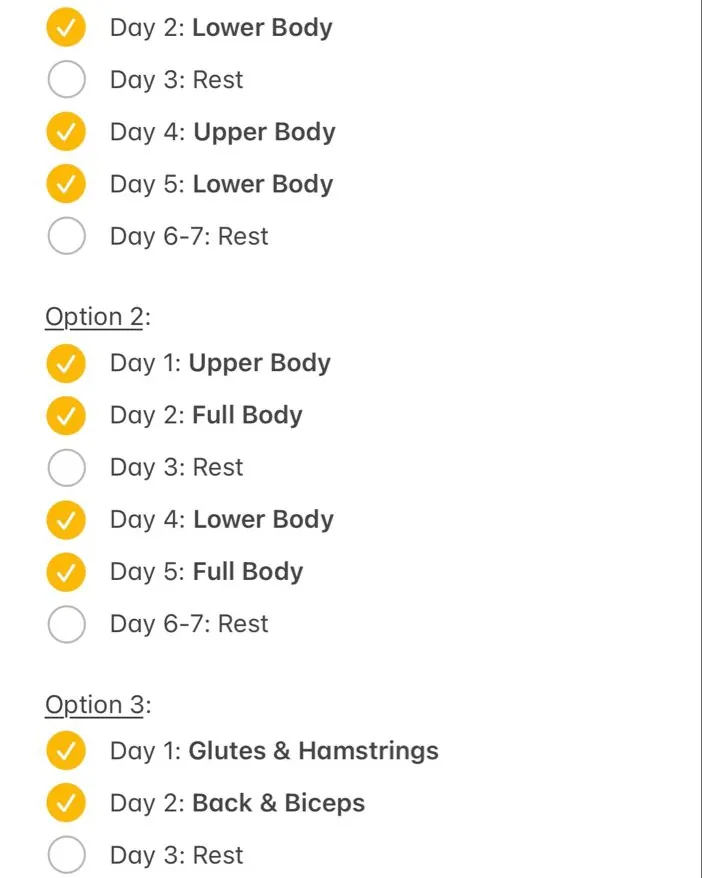
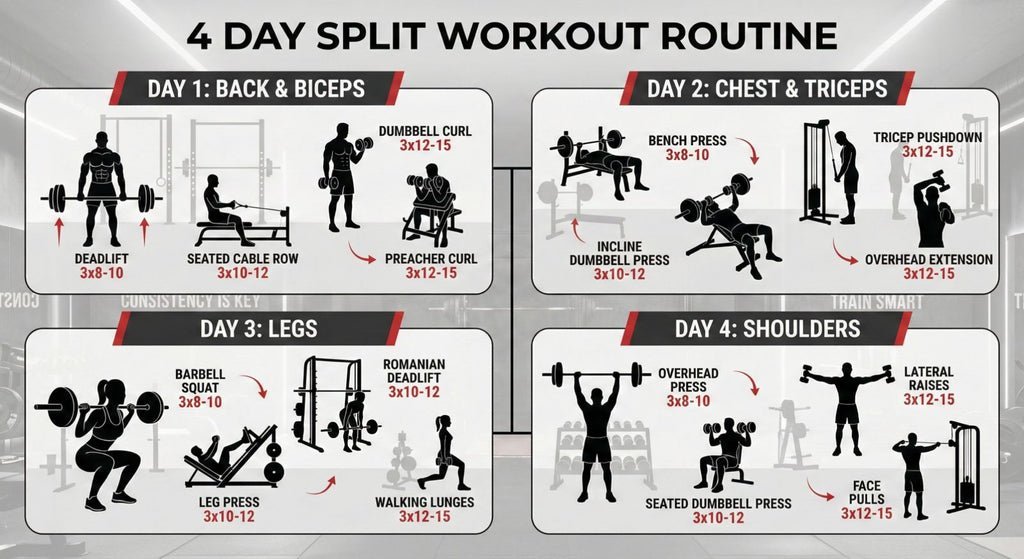
Here you split by movement: pushing muscles, pulling muscles, legs, then a fourth day for whatever lags.
- Day 1 — push: bench or overhead press first, 4 sets of 5-8 reps.
- Day 2 — pull: rows and pull-ups, 4 sets of 6-10 reps.
- Day 3 — legs: squats or deadlifts, 4 sets of 3-6 reps.
- Day 4 — weak point: 3 exercises for one muscle, 3 sets of 10-15 reps.
- Rest on the other three days.
It gives a lagging muscle real attention. The cost is recovery — four hard days back to back will wear you down, so most people need a rest day between day 3 and day 4.
How full body, four short days works
Full body four times a week suits anyone with only 45 minutes, but volume per session has to drop.
- Each session: 1 squat or hinge, 1 push, 1 pull, 1 carry or core move.
- Sets: 2-3 per exercise, 5-8 reps on the big lifts.
- Rest: 90 seconds between sets, no longer.
- Leave at least one full day between sessions.
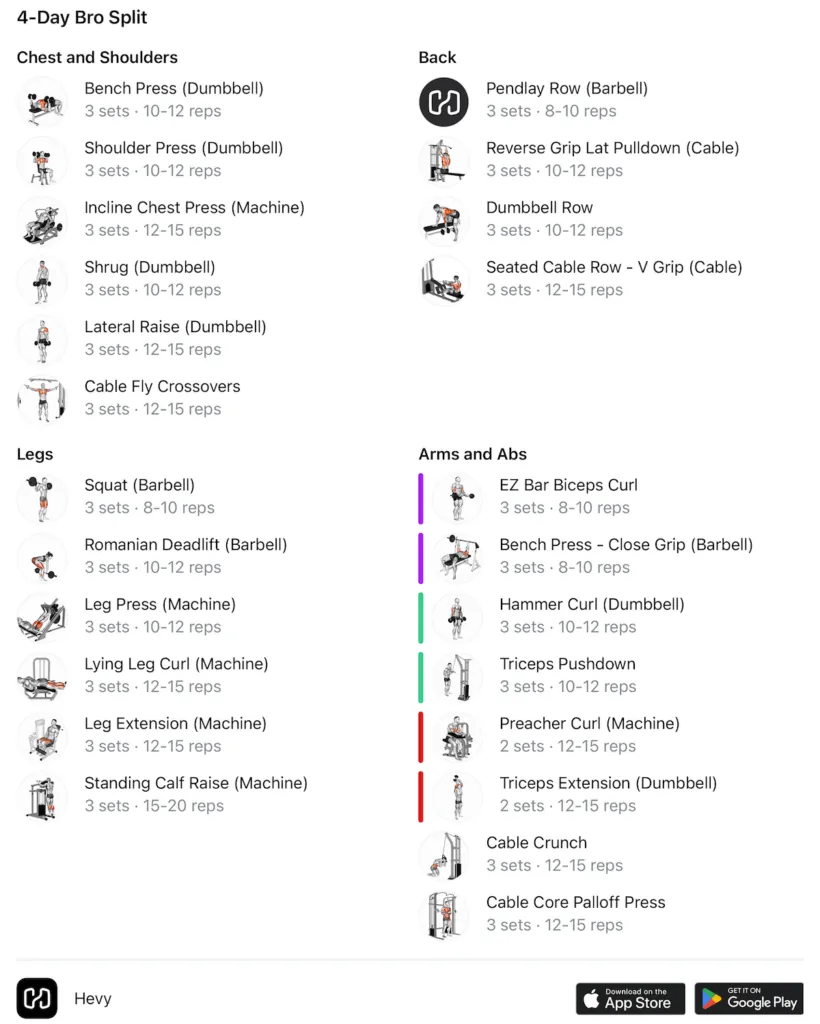
The upside is that a missed day costs you little. The downside is that you can’t push any single muscle hard — there isn’t enough time. A body-part bro split, where each day is one muscle, also fits four days, but it trains each muscle only once a week and suits advanced lifters far better than beginners.
Which split fits your situation?
If you’re in a hurry, run full body four times a week — 45-minute sessions fit around work, and skipping one doesn’t wreck the week. If it’s your first time in the gym, pick upper/lower twice a week; two movement patterns are far easier to learn than six, and you’ll add weight faster.
If you want the best result whatever it takes, push/pull/legs plus a weak-point day gives the most room to grow one area. The trade-off never disappears: the more days you train, the more recovery you owe your body.
The rules for every 4-day split
Whichever layout you pick, a few things stay the same. The Physical Activity Guidelines for Americans from the U.S. Department of Health and Human Services set the baseline: adults need at least 150 minutes of moderate activity a week, plus muscle-strengthening work on 2 or more days.
Before you start, write your four days down and pick the weights you’ll use. Partway through, check one thing — are you adding reps or weight every week or two? If not, you’re not recovering enough. At the end of each block, take a lighter week. If you have a heart condition, an old injury or you’re pregnant, get cleared by a doctor before you start.
Related guides
- 30-Day Workout Plan for Fast Results & Total Body Fitness
- Best Weight Cage for Home Gym 2026: Top Picks for Serious Lifters
- Best Bumper Plates for Lighter Lifters 2026: Top Picks for Home Gyms
Frequently asked questions
Is a 4-day split good for beginners?
Yes, if you pick upper/lower or full body. Beginners add strength fast, and four days gives enough practice without frying your recovery. A one-muscle-per-day split is too much volume for a first year.
How long should each session last?
About 60-75 minutes for upper/lower, and 45-60 for full body. Go past 90 minutes and most people are resting, not training. Cut exercises rather than rushing your sets.
Can I do a 4-day split on back-to-back days?
You can, but keep hard leg days apart. Two upper days in a row is fine for most people; two heavy squat days back to back is not. Put at least one rest day between your two lower sessions.
How many rest days do I need?
Three. Four training days leaves three for rest or light walking, and that’s the split most people recover from. If you feel flat for two sessions in a row, add a fourth rest day.
Is it safe to train four days a week?
Yes for most healthy adults, and the U.S. guidelines above support it. Stop and see a doctor if you get chest pain, dizziness or joint pain that lingers past a few days.
What happens if I miss a training day?
Nothing much — just pick up where you left off. Don’t stack two sessions into one day to catch up. With upper/lower, a missed day only costs you one muscle group that week.
Do I need supplements on a 4-day split?
No. Food covers it for most people. Protein from meals, enough sleep and water matter more than any powder. Ask a doctor or dietitian before adding anything.
Conclusion
Four days a week is plenty to build real strength, and the layout matters less than showing up. Pick upper/lower if you’re unsure, run it for eight weeks, and change only when progress actually stops.

I am a certified fitness coach with over 10 years of experience helping people improve their strength, endurance, and overall health. Specializes in workout programming, weight training, fat loss, muscle building, home fitness, and evidence-based nutrition.My goal is to make fitness simple and practical through well-researched guides, honest product reviews, and actionable training advice.